

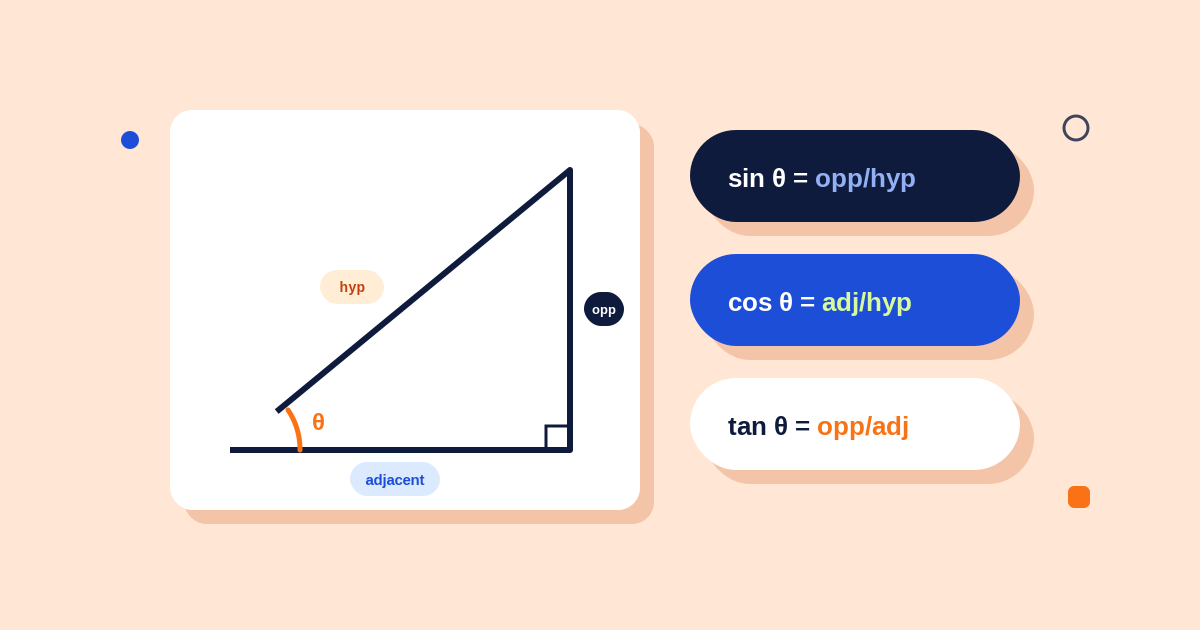
Trigonometry is an important part of mathematics that helps us understand angles, triangles, distances, and measurements.
Three of its most frequently used functions are sine (sin), cosine (cos), and tangent (tan).
These functions appear in geometry, physics, engineering, architecture, and many other subjects.
Although the formulas may initially seem complicated, calculating sine, cosine, and tangent becomes straightforward once you understand how the functions work.
In this guide, we'll explain the three functions, show you how to calculate them using a scientific calculator, and explore common mistakes to avoid.
What Are Sin, Cos, and Tan?
Sine, cosine, and tangent describe relationships between angles and sides of a right-angled triangle.
A right triangle has one angle measuring 90 degrees.
The three sides are known as:
- Hypotenuse: The longest side, opposite the right angle.
- Opposite: The side directly opposite the angle being considered.
- Adjacent: The non-hypotenuse side next to that angle.
The three trigonometric ratios are based on these relationships.
Understanding the SOH-CAH-TOA Formula
A popular way to remember the three basic trigonometric formulas is SOH-CAH-TOA.
Sine (SOH)
Sine equals opposite divided by hypotenuse.
sin(θ)=(Opposite)/(Hypotenuse)
Cosine (CAH)
Cosine equals adjacent divided by hypotenuse.
cos(θ)=(Adjacent)/(Hypotenuse)
Tangent (TOA)
Tangent equals opposite divided by adjacent.
tan(θ)=(Opposite)/(Adjacent)
These formulas apply to acute angles in a right triangle.
More broadly, sine, cosine, and tangent can be defined using the unit circle, allowing them to work with other angles as well.
How to Calculate Sin Using a Scientific Calculator
Suppose you want to find the sine of 30 degrees.
Step 1: Open the Utilizeio Scientific Calculator.
Step 2: Set the angle format to degrees.
Step 3: Enter:
sin(30)
Step 4: Calculate the expression.
Result: 0.5
This means that in a right triangle with an angle of 30 degrees, the ratio of the opposite side to the hypotenuse is 0.5.
How to Calculate Cos Using a Scientific Calculator
Suppose you need to calculate the cosine of 60 degrees.
Select degree mode, then enter:
cos(60)
Result: 0.5
You can interpret this as the adjacent side being half the length of the hypotenuse in a right triangle with a 60-degree angle.
How to Calculate Tan Using a Scientific Calculator
Suppose you want to calculate the tangent of 45 degrees.
Select degree mode and enter:
tan(45)
Result: 1
This means the opposite and adjacent sides have equal lengths for a 45-degree angle in a right triangle.
Sin, Cos, and Tan Values for Common Angles
The following table contains important trigonometric values.
| Angle | sin | cos | tan |
|---|---|---|---|
| 0° | 0 | 1 | 0 |
| 30° | 1/2 | √3/2 | 1/√3 |
| 45° | 1/√2 | 1/√2 | 1 |
| 60° | √3/2 | 1/2 | √3 |
| 90° | 1 | 0 | Undefined |
For reference, 1/sqrt(2) is approximately 0.7071 and sqrt(3) is approximately 1.7321.
These values are useful for solving many common mathematics problems.
Degrees vs. Radians: What's the Difference?
Scientific calculators commonly support two angle measurement modes: degrees and radians.
Degree Mode
Degrees divide a complete circle into 360 equal units.
Examples include:
- 90° — one-quarter turn
- 180° — half turn
- 360° — full turn
Degree mode is frequently used in introductory geometry.
Radian Mode
Radians provide another way of measuring angles.
A complete circle measures 2π radians.
Important conversions include:
| Degrees | Radians |
|---|---|
| 30° | π/6 |
| 45° | π/4 |
| 60° | π/3 |
| 90° | π/2 |
| 180° | π |
| 360° | 2π |
For example:
sin(30) in degree mode equals 0.5.
In radian mode, the equivalent expression is:
sin(pi/6)
Both represent the same angle and give the same mathematical result, subject to floating-point rounding.
Always verify the calculator's angle setting before evaluating trigonometric expressions.
How to Find an Unknown Triangle Side
Let's solve a practical example.
Suppose a right triangle has:
- An angle of 30 degrees
- A hypotenuse measuring 10 cm
- An unknown opposite side
Using the sine formula:
sin(30°)=(Opposite)/(10)
Rearrange:
Opposite=10 × sin(30°)
Since sin(30°) = 0.5:
Opposite=10 × 0.5=5 cm
You can verify the answer using the online scientific calculator.
This method is useful in geometry, construction-related calculations, and introductory physics problems.
What Are Inverse Trigonometric Functions?
Sometimes you know the ratio of two triangle sides but need to determine the angle.
Inverse trigonometric functions help you find the angle corresponding to a given ratio.
The three common inverse functions are:
- arcsin (sin⁻¹)
- arccos (cos⁻¹)
- arctan (tan⁻¹)
For example:
sin^(-1)(0.5)=30°
Here, sin⁻¹ means inverse sine, not one divided by sine.
Utilizeio provides inverse trigonometric functions, allowing you to work backward from ratios to principal angle values.
Make sure the selected degree or radian mode matches the unit you want for the result.
Common Trigonometry Mistakes
Using the Wrong Angle Mode
Entering a degree value while the calculator is set to radians produces an unexpected answer.
Confusing Opposite and Adjacent Sides
The opposite and adjacent sides depend on which acute angle you're considering.
Confusing Inverse Sine With Reciprocal Sine
Inverse sine, sin⁻¹(x), is different from 1/sin(x).
Dividing by Zero
Tangent is undefined when cosine equals zero, including at 90° and 270°.
Rounding Too Early
Avoid rounding intermediate calculations unnecessarily. Keep sufficient precision until the final answer.
Where Are Sin, Cos, and Tan Used?
Physics: Resolving forces into horizontal and vertical components.
Engineering: Working with angles, periodic motion, and geometric measurements.
Architecture and construction: Understanding inclines, angles, and lengths.
Mathematics education: Solving triangles and learning trigonometric identities.
Computer graphics: Calculating positions and rotations in two-dimensional and three-dimensional applications.
Frequently Asked Questions
How do you calculate sin on a scientific calculator?
Choose the correct angle mode, enter the sine function and angle, then calculate. For example, sin(30) in degree mode equals 0.5.
What is the difference between sine and cosine?
In a right triangle, sine is the ratio of opposite to hypotenuse, while cosine is adjacent to hypotenuse.
What does tan mean in mathematics?
Tangent is the ratio of the opposite side to the adjacent side of a right triangle.
Why does sin(30) sometimes give the wrong answer?
The calculator may be set to radians rather than degrees.
Can I calculate inverse trigonometric functions online?
Yes. Use the inverse sine, cosine, or tangent function in a scientific calculator that supports them.
Is tangent always defined?
No. Tangent is undefined wherever cosine equals zero.
Conclusion
Understanding sine, cosine, and tangent is an essential step in learning trigonometry.
Once you know the SOH-CAH-TOA formulas and how angle modes work, solving basic trigonometric problems becomes much easier.
You can practice these calculations directly in your browser using Utilizeio.
Calculate Sin, Cos, and Tan with Utilizeio
Related Tools
- Scientific Calculator — Evaluate trigonometric expressions.
- Percentage Calculator — Calculate percentages and proportional changes.
- Fraction Calculator — Perform operations on fractions and mixed numbers.