

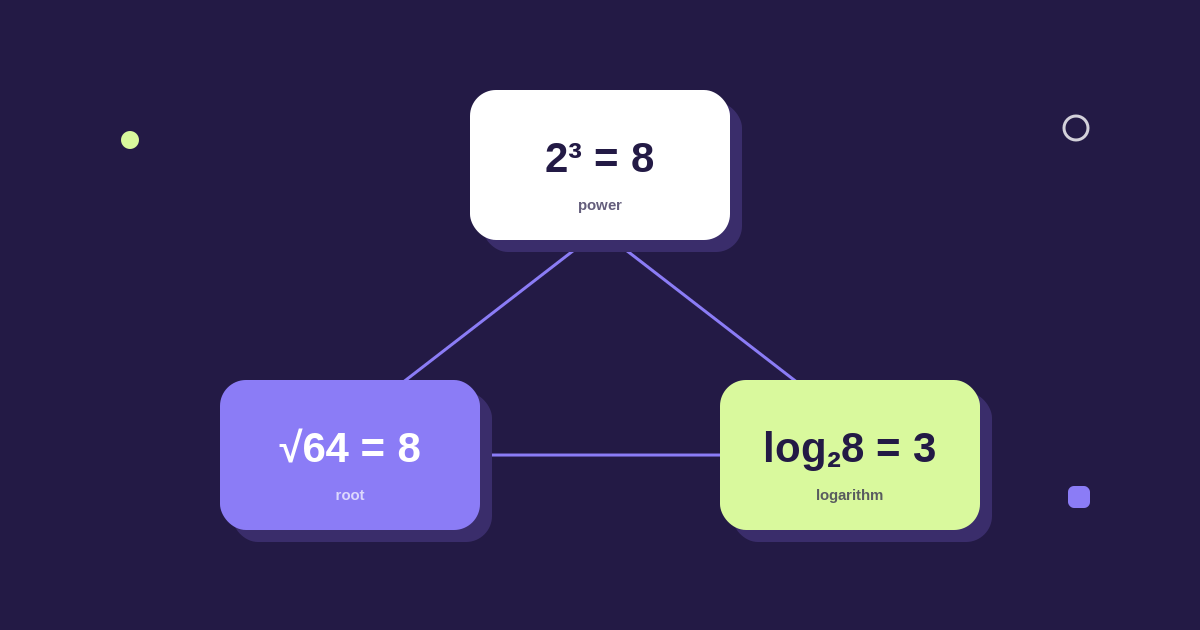
Logarithms, powers, and square roots are important mathematical concepts used in algebra, science, engineering, and many everyday calculations.
Although these operations may look complicated at first, they become easier once you understand the relationship between them.
A scientific calculator can evaluate these mathematical expressions without requiring you to perform long calculations manually.
In this guide, we'll explain how logarithms, powers, and square roots work, walk through practical examples, and show you how to evaluate them using the Utilizeio Scientific Calculator.
What Are Powers and Exponents?
A power is a mathematical expression that describes repeated multiplication of the same base.
For example:
2^4=2 × 2 × 2 × 2=16
In this expression:
- 2 is the base.
- 4 is the exponent.
- 16 is the result.
The exponent tells you how many times the base is used as a factor when the exponent is a positive integer.
Powers also work with zero, negative, and fractional exponents, subject to the mathematical domain.
Common Examples of Powers
| Expression | Meaning | Result |
|---|---|---|
| 2³ | 2 × 2 × 2 | 8 |
| 3⁴ | 3 × 3 × 3 × 3 | 81 |
| 5² | 5 × 5 | 25 |
| 10³ | 10 × 10 × 10 | 1,000 |
| 2⁰ | Any nonzero base raised to zero | 1 |
How to Calculate Powers Online
Suppose you need to calculate 7 raised to the power of 3.
Step 1: Open the Utilizeio Online Scientific Calculator.
Step 2: Enter:
7^3
Step 3: Press Enter or the equals button.
Result: 343
You can also use the calculator's power function for larger expressions.
Understanding Negative Exponents
A negative exponent represents a reciprocal.
For a nonzero base:
a^(-n)=(1)/(a^n)
For example:
2^(-3)=(1)/(8)=0.125
This is useful when working with scientific formulas and small quantities.
What Is a Square Root?
A square root is a value that produces a given number when multiplied by itself.
For example:
sqrt(81)=9
Because:
9 × 9=81
The square-root symbol √ normally represents the principal, nonnegative square root.
Common Square Root Values
| Number | Square root |
|---|---|
| 4 | 2 |
| 9 | 3 |
| 16 | 4 |
| 25 | 5 |
| 64 | 8 |
| 100 | 10 |
| 144 | 12 |
How to Calculate Square Roots Online
Suppose you want to find the square root of 225.
Open the scientific calculator and enter:
sqrt(225)
Result: 15
The calculator can also evaluate roots that are not whole numbers.
For example:
sqrt(2) ≈ 1.41421356
The displayed precision depends on the calculator's numerical formatting.
Square Roots and Fractional Exponents
Square roots can also be expressed using fractional powers.
For nonnegative real numbers:
sqrt(x)=x^(1/2)
For example:
16^(1/2)=4
This connection is useful when studying algebra and exponent rules.
What Is a Logarithm?
A logarithm answers a simple mathematical question:
To what power must a base be raised to produce a particular number?
For example:
log_10(100)=2
Because:
10^2=100
In general:
log_b(x)=y
means:
b^y=x
Here, the logarithm base must be positive and different from 1, and the logarithm's argument must be positive.
Understanding Common Logarithms
A common logarithm uses base 10.
It is normally written as:
log_10(x)
Examples:
| Expression | Result |
|---|---|
| log₁₀(10) | 1 |
| log₁₀(100) | 2 |
| log₁₀(1,000) | 3 |
| log₁₀(1) | 0 |
| log₁₀(0.1) | -1 |
Common logarithms are used in logarithmic scales, scientific notation, and various mathematical applications.
How to Calculate Common Logarithms Online
Open the scientific calculator.
Enter:
log(1000)
Result: 3
This works because 10 raised to the third power equals 1,000.
What Is a Natural Logarithm?
A natural logarithm uses Euler's number, approximately 2.71828, as its base.
It is written:
ln(x)=log_e(x)
Natural logarithms are widely used in calculus, exponential growth, continuous compounding, and mathematical modeling.
For example:
ln(e)=1
Because:
e^1=e
Another important identity is:
ln(1)=0
How to Calculate Natural Logarithms
Use the ln function on the scientific calculator.
For example:
ln(1)
Result: 0
To evaluate the natural logarithm of a positive number, enter it as the argument of the ln function.
Difference Between Log and Ln
| Feature | Log | Ln |
|---|---|---|
| Base | 10 | e ≈ 2.71828 |
| Example | log(100) = 2 | ln(e) = 1 |
| Common usage | Base-10 scales and calculations | Calculus and continuous growth |
| Input domain | Positive real numbers | Positive real numbers |
Both are logarithmic functions, but they use different bases.
Be aware that some mathematical and programming contexts use log to mean the natural logarithm. Utilizeio's scientific calculator provides separate log and ln functions.
Important Exponent and Logarithm Rules
Understanding the basic rules can simplify many mathematical expressions.
Product of Powers
When multiplying powers with the same base:
a^m × a^n=a^(m+n)
Example:
2^3 × 2^2=2^5=32
Quotient of Powers
When dividing powers with the same nonzero base:
(a^m)/(a^n)=a^(m-n)
Example:
(3^5)/(3^2)=3^3=27
Power of a Power
(a^m)^n=a^(mn)
Example:
(2^3)^2=2^6=64
Logarithm Product Rule
For positive x and y and a valid logarithm base:
log_b(xy)=log_b(x)+log_b(y)
Logarithm Power Rule
For positive x:
log_b(x^n)=nlog_b(x)
These rules are useful in algebra, science, and other mathematical applications.
Practical Uses of Powers, Roots, and Logarithms
Algebra
Powers, roots, and logarithms help solve equations involving unknown values.
For example, solving:
x^2=49
gives:
x=7 or x=-7
Both solutions must be considered because squaring either value produces 49.
Geometry
Square roots are used in the Pythagorean theorem:
c=sqrt(a^2+b^2)
For a right triangle with legs measuring 3 and 4:
c=sqrt(3^2+4^2)=sqrt(25)=5
Finance
Exponents appear in compound interest formulas, while logarithms can help solve for time or rates under appropriate mathematical assumptions.
For savings projections, the Utilizeio Compound Interest Calculator provides a more specialized interface.
Science
Logarithms are used in scientific scales, exponential relationships, and mathematical modeling.
Computer Science
Powers and logarithms are fundamental in algorithm analysis, numerical computing, and data structures.
Common Mistakes to Avoid
Confusing logarithms and powers: A logarithm asks for an exponent, whereas exponentiation applies an exponent.
Using negative inputs with real logarithms: Real-valued logarithms are defined only for positive arguments.
Ignoring parentheses: Expressions such as 2^3^2 are not equivalent to (2^3)^2. Utilizeio interprets the ungrouped expression as 2^((3^2))=512.
Confusing negative signs and powers: -2^2 evaluates to -4 because exponentiation takes precedence over unary negation.
Assuming every square root is a whole number: Many square roots have irrational values and require approximate decimal representations.
Frequently Asked Questions
How do I calculate logarithms using a scientific calculator?
Use the log function for common logarithms or ln for natural logarithms, enter a positive argument, and evaluate the expression.
What is the logarithm of 100?
The common logarithm of 100 is 2 because 10² equals 100.
How do I calculate a number raised to a power?
Enter the base followed by the power operator and exponent. For example, 3^4 equals 81.
Can I calculate square roots online?
Yes. Use the square-root function in an online scientific calculator.
What is the difference between log and ln?
Common logarithms use base 10, while natural logarithms use Euler's number as their base.
Can I calculate the square root of a negative number?
Not within the real-number system. Negative numbers have complex square roots, which require complex-number support. Utilizeio's scientific calculator is limited to real finite results.
Conclusion
Understanding powers, square roots, and logarithms helps build a stronger foundation in mathematics.
These concepts are connected and appear throughout algebra, geometry, physics, engineering, and financial mathematics.
With a scientific calculator, you can practice each operation and check your results quickly.
Try the Free Utilizeio Scientific Calculator
Related Tools
- Scientific Calculator — Evaluate powers, logarithms, and roots.
- Compound Interest Calculator — Explore compound growth.
- Average Calculator — Calculate mean and other numerical summaries.